

By Andrew Wells, Interim Lead Product Owner, MyPRI Solutions & Technology, Eilidh Wagstaff, Senior Specialist, Investment Practices and Tom Attwooll, Senior Specialist, Investment Practices
Asset owner signatories are operating in a period characterised by rapid market shifts, geopolitical uncertainty and rising responsible investment expectations from beneficiaries and members. In this environment, understanding and managing the risks and opportunities stemming from sustainability issues forms a core part of long-term value protection and creation. It is therefore unsurprising that 2025 PRI reporting data shows continued growth in the proportion of signatories incorporating material sustainability considerations into investment analysis, investment decision-making and stewardship activities.
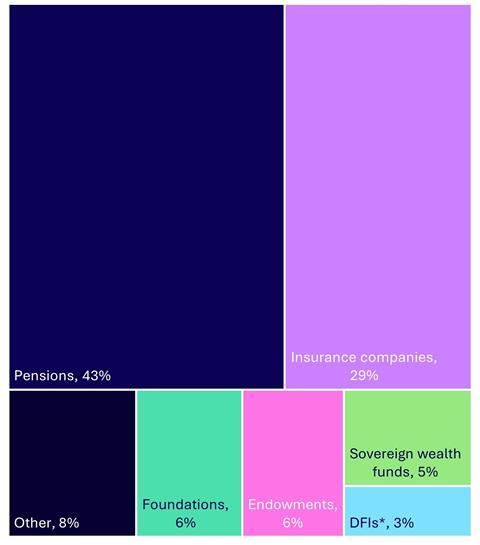
The PRI has over 700 asset owner signatories; of the 380 that reported in full in 2025, 43% are pensions and 29% are insurers, with foundations, endowments, sovereign wealth funds, development finance institutions and others making up smaller portions. Total assets under management of the asset owners that reported in 2025 stood at US$15.6 trillion. Around 90% of reporting asset owners outsource management of at least part of their assets to external managers, highlighting how central manager oversight is to responsible investment.
PRI asset owner sigatories by type
Source: OO1 (2025)|Denominator: 380.
Here we summarise the key themes that emerge from data reported by PRI asset owner signatories in 2025 and make comparisons with investment managers.
Asset owners are paying increasing attention to how investment managers deal with system-level risks
Asset owners are placing stronger emphasis on how external managers identify and address system-level risks across all asset classes. Compared to previous years, a larger proportion are evaluating managers’ approaches to analysing system-level issues, such as climate change and nature loss. In addition, asset owners are more likely than investment managers to assess how analysis of system-levels issues is being incorporated into investment decisions and stewardship practices, signalling a move toward more forward looking risk oversight.
(Proxy) voting records in the spotlight
Asset owners that allocate to externally managed listed equity strategies increasingly assess managers’ proxy voting records as part of selection, reflecting heightened focus on alignment and accountability. Evaluations tend to look at high level voting policies and their alignment with investment mandates (79% of asset owners reported that they took this step), while more granular analysis of individual votes cast for and against or votes related to systematic sustainability issues are less common. The data reflects a growing expectation that managers’ voting practices consistently reflect asset owners’ responsible investment objectives.
Asset owners increasingly include responsible investment-related clauses in contractual agreements with managers
An increasing number of asset owner signatories are incorporating responsible investment-related clauses into contractual agreements with external managers, rising to 91% in 2025 from 81% in 2024, evidencing a growing emphasis on formalising these expectations.
Escalation with investment managers becoming more structured
Asset owners responsible investment policies increasingly document how they escalate concerns about investment managers’ responsible investment practices. Engagement remains the most common first step (mentioned by 80% of asset owner respondents), but many asset owners are also willing to take more assertive measures, such as placing managers on watch lists (56%), holding off from making any new allocations to the manager (50%) or ultimately terminating mandates (49%). The numbers demonstrate a readiness among asset owners to act when misalignment persists.
Monitoring of responsible investment practices less common for passive allocations
Despite overall progress in manager monitoring, a notable portion of asset owners are yet to develop approaches for evaluating responsible investment practices in passive allocations. For example, around 20% of asset owners with passive fixed income allocations are not monitoring how investment managers are conducting stewardship in relation to these holdings.
Asset owners’ and investment managers’ responsible investment practices diverge in some key areas
Investors with board-level oversight of and accountability for responsible investment
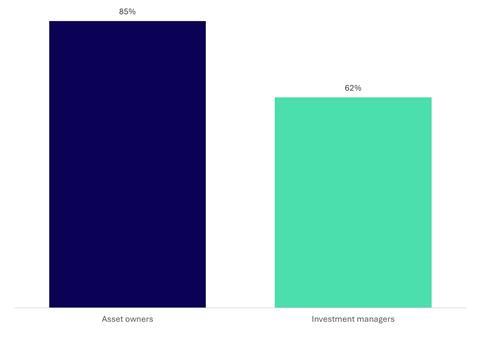
While there are commonalities between asset owners’ and investment managers’ approaches to responsible investment, there are areas where their practices diverge. For example, a higher proportion of asset owners assign board-level oversight of responsible investment compared with investment managers (85% versus 62%), though both groups are equally likely to use responsible investment key performance indicators (KPIs) to evaluate their senior executives (44% and 43%).
Many asset owners and investment managers identify (80%) and address (70%) sustainability outcomes, with both groups adopting widely recognised frameworks to do so. However, when it comes to analysing and addressing climate-related risks and opportunities, reporting data uncovered several differences.
Asset owners are more likely than investment managers to:
- apply the Paris Agreement as a framework to identify sustainability outcomes (46% vs 29%);
- use climate scenario analysis (61% and 36%);
- use or disclose climate-related metrics and variables (78% compared with 65%);
- report progress towards climate-related commitments to their clients/beneficiaries (68% and 57%);
- apply exclusions based on the organisation’s climate change commitments (46% and 30%).
These differences may reflect asset owners’ longer term investment horizons and greater ability to set organisation wide climate policies and strategies, compared with investment managers who more often operate under client defined mandates and shorter term performance pressures. Noting where these divergences are particularly pronounced can help inform dialogue between asset owners and managers on aligning expectations and approaches on responsible investment.
Summary
Data from the 2025 PRI reporting cycle highlights a continued shift among asset owners towards more structured approaches to responsible investment. By strengthening manager selection and monitoring processes, increasingly formalising expectations through contractual arrangements and expanding their focus on system-level sustainability risks, asset owners are reinforcing their role in safeguarding long term value.
The PRI is supporting this shift by creating more space for asset owners to lead. We will establish new working structures – including an innovation group – so asset owners can convene, collaborate and innovate on the issues shaping the future of responsible investment. We will also launch an annual Asset Owner Risk Sentiment Survey, which will gather input from asset owner CIOs on the sustainability and governance-related risk factors that matter most to their processes. In addition, we will expand the global and regional Asset Owner Forums initiated in 2025 to improve visibility of shared priorities and strengthen PRI-supported, asset owner-led dialogue, and will continue to explore other actions to support asset owners.
This blog is one in a series covering high-level insights derived from signatories’ 2025 reporting data. PRI signatories can access more detailed analysis in the summary reports and the PRI Data Portal.