

Andrew Wells, Interim Lead Product Owner, MyPRI Solutions & Technology; Adele Shraiman, Specialist, Climate; and Daniel Gallagher, Senior Lead, Climate
Amidst record warming, worsening climate impacts and the reshaping of global energy markets, the imperative to understand and act on climate-related risks has never been clearer. PRI’s 2025 reporting cycle highlighted seven clear ways that investors are addressing climate risks through their investment practices.
1. Climate risks and opportunities are now a near universal part of financial thinking
Recognition of climate-related financial risks and opportunities is now broadly established across the market, with 80% of PRI signatories reporting that they have a process in place to identify them. This is now translating into action, with a growing number of signatories developing processes to manage climate-related risks, up to 45% in 2025 from 39% in 2024. This includes increasing uptake of transition planning, a dynamic and iterative process through which entities develop an organisation-wide approach to the broader economic transition to net zero.
Percentage of signatories that have a process to identify, assess and manage climate-related risks
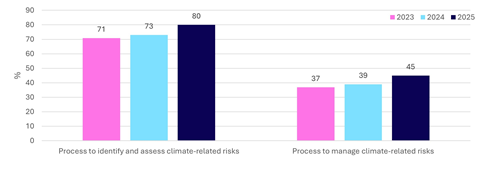
Based on PGS 44 (2025)|Denominator: 2,777 (2025), PGS 44 (2024)|Denominator: 3,048 (2024), PGS 44 (2023)|Denominator: 3,774 (2023)
2. Board-level oversight of climate issues is increasing
Evidence from the market has consistently shown that climate governance is most effective when it sits at the highest levels of organisational leadership. Reflecting this, board-level oversight of climate issues among PRI signatories has climbed from 30% in 2023 to 36% in 2025 – a sign that more organisations are embedding climate considerations within the senior leadership’s remit.
This trend is also visible at the executive level, where the proportion of signatories with senior executive oversight of climate issues has risen from 56% in 2023 to 66% in 2025. These increases point to a maturing governance landscape in which climate-related financial risks are increasingly treated as a core leadership responsibility.
3. Investor climate policies are prevalent across the signatory base
Formal policies can guide investors’ overall approaches to responsible investment and/or specific environmental, social and/or governance issues. In 2025, 88% of reporting signatories indicated that they had formal policies on environmental factors (up from 80% in 2023) and 75% had dedicated climate policies (65% in 2023). Climate-related policies provide information on the organisation’s management of climate-related financial risk in the context of investment and stewardship activities, including transition plans.
The reporting data also shows an increasing number of signatories making their policies publicly available. Climate-related policies are moving from being optional to expected, and most investors now articulate their principles and their practical approaches to financially material climate risks.
4. Climate screening remains stable despite market conditions
Despite significant market headwinds, investors continue to integrate climate considerations into the investment process. A significant and growing segment of PRI signatories actively screen investments in portfolio companies based on climate commitments. Asset owners show higher uptake of climate-commitment screening (at 46%) compared to investment managers (30%). This reflects long-term investors’ (including pension funds and insurers) increasing recognition that the management of system-level climate risks is a core fiduciary responsibility aligned with long-term interests.
The number of signatories maintaining climate-related exclusions has been consistent over the last several years, at roughly 32%.
5. Scenario analysis is gaining traction but remains challenging
Scenario analysis remains an important tool for analysing the potential long-term financial impacts of climate change. Despite being technically challenging for many investors, the consistent adoption of scenario analysis reflects recognition of its value in navigating uncertainty and maintaining long-term resilience.
More than a third of signatories (39%) are now using scenario analysis to assess risks and opportunities, and 32% of those are opting to use scenarios other than those provided by the IEA, IPR or One Earth.
6. Climate reporting to clients and beneficiaries is increasingly common
Transparency is improving, with a growing proportion of signatories reporting their climate commitments (62%) – and progress against them (58%) – to clients and beneficiaries. The slight upward trend since 2024 reflects growing expectations for transparency, driven not only by regulatory requirements but also by clients seeking clearer insight into how climate considerations shape investment decisions.
7. Use of climate metrics remains stable
The climate metrics adopted by reporting signatories have remained broadly similar over time, with 56% of signatories reporting total carbon emissions (50% in 2024), 41% reporting weighted average carbon intensity (WACI) or similar intensity metrics (36% in 2024) and 32% reporting on exposure to physical risk (29% in 2023). However, one third of signatories report either not using climate metrics or not disclosing them.
Climate action is advancing, with clear opportunities for further progress
As climate impacts continue to unfold, PRI signatories are progressing in their assessment and management of material climate risks. The 2025 reporting cycle shows steady headway across the suite of investor levers, from risk assessment and governance to metrics and portfolio screening. There are clear opportunities for further progress, notably on the assessment of system-level risks and the use of forward-looking analysis to drive informed decision-making. In the months ahead, the PRI’s Climate Reference Group will convene signatories to examine the forefront of climate issues, while PRI guidance and collaborative initiatives will continue to support signatories to advance their practice. Signatories can access PRI resources by logging in to MyPRI.
Further reading:
PRI (2025), Institutional investor action on climate risk as the world approaches the 1.5°C limit of the Paris Agreement
PRI (2026), Toward Transition Intelligence: Navigating a multi-speed transition through investor transition planning
PRI (2026) Global responsible investment trends 2026: PRI Reporting data
References