

Bethany Davies, Senior Analyst, Climate and Environment and Adèle Shraiman, Specialist, Climate
Accelerating AI deployment and data centre infrastructure have implications for climate and nature. In this blog we consider:
- how AI is reshaping physical and transition risks;
- early investor responses;
- initial steps signatories can take when developing their approach to AI.
This follows on from our blog on how AI-related sustainability risks are starting to play out in investor portfolios.
AI is intensifying climate and nature-related risks and creating new exposures for investors
Some of the most obvious climate- and nature-related risks are linked to the rapid expansion of AI data centres. Associated pressures – including increased power demand and electronic waste, water use and pollution issues, and impacts of mineral extraction – are already translating into financial risks.
Google’s US$200 million data centre in Chile provides an example of how environmental pressures can create project risks. Originally proposed in 2020, the project faced community opposition and legal challenges over aquifer use for cooling. As a result, the centre was redesigned with an air-cooling system instead, leading to significant delays.
AI is also beginning to increase climate- and nature-related risk exposure for a range of sectors, including technology and financial services which now face risks to which they were not significantly exposed in the past. Plus, efficiency gains are driving higher overall resource use through so-called rebound effects – where savings in one area stimulate greater consumption overall – which remain poorly addressed by existing governance and regulatory frameworks.
Key climate- and nature-related risks associated with AI
Adapted from Stern et al. (2025) and MIT Technology Review (2024)
Energy demand
Global data centre electricity use is expected to more than double from 2024 to 2030, exposing investors to power price volatility and grid constraints with knock-on effects on operating costs, and potential misalignment with portfolio transition pathways.
Rising emissions
Powering AI data centres could increase emissions by 0.4–1.6 GtCO2 e* annually by 2035, while embodied emissions from data centre construction are set to increase investors’ portfolio exposures to potential transition and other system-level climate risks.
Water usage
Data centre cooling could withdraw 4.2−6.6bn m3 of water per year by 2027, including from water-stressed regions. Pressures are already translating into site constraints, permitting challenges and community opposition, leading to delays, increased costs and reputational risks.
Critical resources
Rising demands for materials (e.g. gallium, lithium) from concentrated supply chains expose investors to operational and geopolitical risks such as price volatility and supply disruptions that may also constrain supply for other transition needs (e.g. wind and solar).
E-waste
Projections suggest electronic waste will accumulate to 5 million tonnes by 2030. With only around 22% of all e-waste currently properly managed, companies face rising compliance and disposal costs, alongside reputational risks and potential loss of recoverable value that transfers to investors.
Rebound effects
Efficiency gains from AI deployment could increase overall demand for energy and resources, offsetting intended sustainability benefits. This can introduce uncertainty around decarbonisation pathways, leading to mispricing of portfolio and systemic risks.
*Gigatonnes of carbon dioxide equivalent
AI may create opportunities for the climate and nature transition
Some investors are already using AI to price in climate and nature risks. For example, AI agents can enhance investment research by stress-testing hypotheses and accessing more granular, underutilised datasets.
AI could be deployed in support of the climate and nature transitions, for example by:
- scaling critical technologies that enable emissions reductions and adaptation across energy systems (e.g. through smarter renewable infrastructure deployment and grid optimisation, including in emerging markets);
- enabling sustainable agricultural practices and improved crop resilience (e.g. testing the safety of pesticides on soils and organisms or predicting supply chain disruptions and farm productivity).
Projected annual global emissions in AI scenario vs. BAU and ambitious emissions reduction scenario by 2035 for three sectors (power, meat and dairy, light road vehicles), from Stern et al. (2025)
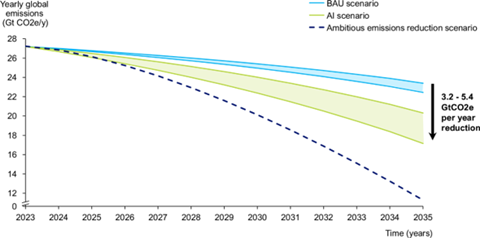
There are also opportunities to improve the sustainability performance and resilience of the AI data centre value chain. These include investments:
- in technologies that reduce data centres’ water usage (e.g. through alternative cooling systems such as using utility wastewater, air cooling or liquid immersion);
- that drive improvements in electronic waste management systems (e.g. through circular designs supporting refurbishment and reuse).
Impax Asset Management published a white paper this month discussing how investors can consider efficiency enhancing solutions across the AI value chain.
How investors are responding
AI is widely viewed as a system-level risk driver that cuts across climate, nature and social issues. Alongside work on AI governance and workforce-related risks, investors are beginning to explore approaches to the climate- and nature-related implications of AI deployment. Using due diligence and stewardship with AI data centre developers to manage risks is a key focus, particularly in relation to energy and water use. Nuveen and the Environmental Defense Fund have published a sustainability due diligence guide for the data centre value chain, covering key environmental and operational risks.
Some investors are also piloting the use of AI to strengthen climate and nature assessments. This includes integrating underused public geospatial and environmental datasets such as the National Oceanic and Atmospheric Administration (NOAA) to support nearer-term physical risk analysis, as well as enabling more granular nature data collection. Goldman Sachs worked with the MIT-IBM Watson AI Lab to pilot AI for nature measurement, supporting nature-related risk and opportunity assessment and investment decision-making.
What can investors do now?
While there is no single approach to AI risks and opportunities, responsible investors could consider the following actions.
Learn and collaborate
- Collaborate with peers, academics and other experts (e.g. via the PRI’s Climate or Nature Reference Groups) to build shared understanding of AI-related risks and opportunities and support more consistent investor practice.
- Participate in new industry initiatives seeking to develop comparable metrics and performance indicators for priority issues such as energy and water usage.
Map exposure
- Identify which companies, sectors and areas of the portfolio are most exposed to AI-related climate and nature risks and opportunities.
- Use existing tools, such as TNFD LEAP assessments or emissions pathway modelling, to test for new AI-related impacts.
Strengthen due diligence
- Integrate AI considerations such as energy use, water use and resource extraction into due diligence and risk assessment frameworks, taking into account impacts across the full value chain and drawing on relevant guidance where helpful (e.g. Nuveen and EDF’s due diligence guide).
Tailor stewardship to AI hyperscalers and deployers
- Engage on AI governance structures (board oversight, accountability and enterprise risk management systems) to build understanding of AI risks and opportunities across sectors.
- Engage with hyperscalers, utilities, semiconductors and data centre operators with a focus on operational and value chain impacts and dependencies such as emissions, water use and community effects.
- Engage with AI deployers with a focus on how their use of AI is creating new climate and nature-related risks and opportunities and their ability to assess, manage and disclose these using existing frameworks.
Engage on policy
- Support systems-level policy engagement where AI-related transition pathways are lagging against international frameworks, such as the Paris Agreement or Kunming-Montreal Global Biodiversity Framework.
- Support regional and national regulation which shapes guardrails on issues such as energy demand, water use and critical mineral extraction.
Test AI in investment practices
- Experiment with AI tools to strengthen investment research and assessment, ensuring adequate governance controls around model assumptions and access to sensitive data (e.g. some biodiversity data can be sensitive to prevent activities like poaching or illegal wildlife trade).
What’s next?
Through its engagement with signatories on the climate- and nature-related risks and opportunities of AI deployment, the PRI is continuing to identify investor support needs. We invite signatories to get in touch to talk about how they are approaching this topic and what types of guidance, case studies and convenings are most useful.