

By Yanni Aissaoui-Helcke, Associate, Human Rights and Social Issues

Under the UN Guiding Principles on Business and Human Rights, investors have a responsibility to engage with stakeholders who may be affected by their – or their investees’ – activities, and to enable access to remedy where stakeholders[1] have been negatively impacted. On top of that, stakeholder engagement and remedy readiness support investee companies in spotting risks early – strengthening business continuity and limiting legal and reputational harm.
These processes can help investors to manage human rights risks, make informed investment decisions and align with international standards. However, the PRI’s reporting data shows that, despite some progress, implementation of these practices – and their integration into human rights due diligence (HRDD) – remains incomplete.
To bridge this gap, the PRI is building on recently published guidance on stakeholder engagement and access to remedy. We have spoken with signatories around the world and convened an event in London to explore how investors are putting these expectations of the UNGPs into practice; this blog shares some of the key insights that emerged.
Understanding stakeholder engagement and remedy readiness
Human rights due diligence (HRDD) is a process through which investors and companies identify, prevent and mitigate actual and potential negative outcomes for people.
Stakeholder engagement is a critical tool for information gathering, implementing the UNGPs and conducting human rights due diligence. It enables investors to better understand human rights risks and triangulate insights from often inconsistent data sources.
Remedy readiness is the extent to which a company has the policies, processes and resources to receive, investigate, address and respond to grievances and provide access to remedy for harm it has caused, contributed to or is linked to through its business activities.
How are investors approaching stakeholder engagement and remedy readiness?
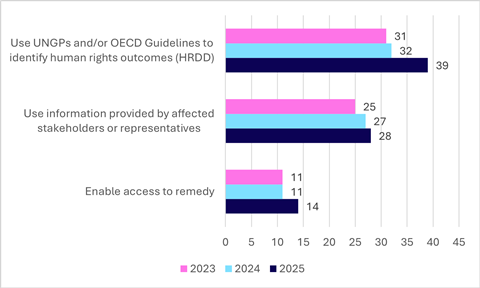
The PRI’s reporting data shows a continued upward trend in investors conducting HRDD. In 2025, 39% of reporters used the UNGPs and/or OECD Guidelines to identify negative human rights outcomes, up from 31% in 2023.
Despite being critical tools for information-gathering and conducting HRDD, only a minority of investors conducting HRDD are integrating stakeholder engagement and remedy readiness into the process. In 2025, just 28% of signatories reported using information from affected stakeholders or their representatives to identify negative outcomes, and only 14% reported enabling access to remedy.
Investors conducting human rights due diligence and related processes
Signatory insights
Recent discussions with signatories highlighted several insights on strengthening stakeholder engagement and remedy readiness.
- Common barriers to conducting and engaging investees on stakeholder engagement and remedy readiness include insufficient local contacts, cultural and language barriers, and limited visibility of on‑the‑ground realities. Trusted intermediaries, such as non-governmental organisations (NGOs) or representative bodies like trade unions, can help bridge some of these gaps. With their on-the-ground access, NGO and trade union reports can provide high-quality insights and support better investor understanding of local impacts.
- Meaningful engagement should be two-way and built on mutual value and a shared understanding of how information will be used and what is achievable with the resources available. It should include communication of how stakeholder input has been considered, what actions or decisions were taken as a result and what outcomes followed (while protecting market or otherwise sensitive information).
- Investors often regard a lack of filed grievances at investee companies as a red flag requiring closer examination. This is particularly relevant in sectors where norms breaches commonly occur in lower supply chain tiers, such as apparel and footwear. A lack of grievances can signal the absence of adequate grievance mechanisms. Leading stewardship approaches involve exploring how far down the supply chain grievances are tracked to ensure they are being captured.
- Upskilling investment teams is essential for identifying negative outcomes. They should be able to recognise common red flags in grievance mechanisms and indicators of weak or ineffective remedy mechanisms.
- Assessing severity and leverage can help investors to prioritise which companies and stakeholders to engage. This includes evaluating the leverage investors have with investees and which stakeholder groups are most meaningfully affected by the company’s actions.
- Collaboration can help address some of these barriers and promote an enabling environment for meaningful and continuous engagement. Initiatives such as Advance can support peer learning and more effective and meaningful engagement, for example by helping reduce time demands on stakeholders.
In 2026, to support signatories to implement the UNGPs, we will look to collate diverse examples of good investor practice. If you have an example that you would be interested in sharing, please reach out to yanni.aissaoui-helcke@unpri.org.
With thanks to Luda Svystunova (Head of Social Research, Amundi) and Mary Beth Gallagher (Director of Engagement, Domini Impact Investments) for developing the remedy guide. We are also grateful to Jessica Wan (Social Lead, Redwheel), Estelle Mandigout (Manager, I&C Responsible Investing, British International Investment), Rachel Hargreaves (Investor Engagement Advisor, UNI Global Union) and Luda for sharing their insights at our recent event.
The PRI blog aims to contribute to the debate around topical responsible investment issues. It should not be construed as advice, nor relied upon. The blog is written by PRI staff members and occasionally guest contributors. Blog authors write in their individual capacity – posts do not necessarily represent a PRI view. The inclusion of examples or case studies does not constitute an endorsement by PRI Association or PRI signatories.
References
[1] In this context, and in the PRI guide, “stakeholders” are understood to include rightsholders – those whose rights are actually or potentially affected by a business activity – their legitimate representatives, or rightsholder organisations.